

Description
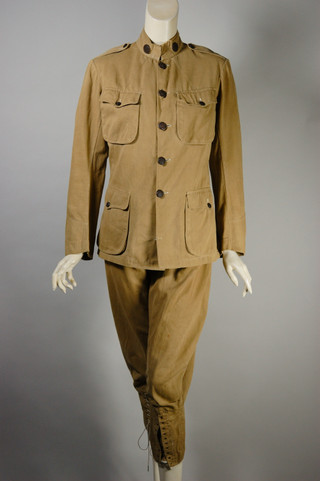
An authentic WW1-era US Army cotton service uniform, this set includes an M1912 olive drab cotton drill tunic and 2 pairs of more-or-less matching breeches. The 2 pairs of breeches include one with lacing and one with buttons on their jodhpur-style tapered legs. Both have a button fly. The tunic jacket has a stand collar and patch pockets. It closes with brass metal eagle buttons. There are 2 brass collar discs: one with “US” and one with “13” over crossed rifles with “K” below, specifying service in the 13th Infantry Regiment, Company K. (See below the measurements for more details about the regiment, if you are interested.)
WWI-era US Army cotton service uniforms were intended for hot weather/tropical climates and/or training camp/garrison duty, stateside. During WW1, shade variations were common, due to supply shortages and dye variations. Cotton uniform colors included both olive drab, like this one, and khaki or tan. While woolen uniforms were standard for the European front, cotton uniforms like this one were heavily used in WW1 training camps due to wool shortages. Cotton service uniforms were also worn post-war by soldiers returning from the front to warmer climates. The heavy cotton fabric is unlined.
The uniform is quite small, shown here on my female mannequin, since it was too tiny to fit on my male form. It would fit a very small/short man, or a large child/small lady, for costume, cosplay, or re-enacting purposes! It is also quite distressed, with many signs of wear and use, some of it perhaps post-war.
The tunic/jacket is overall sturdy and wearable but in poor condition, with significant stains and holes on both sides of the right sleeve. There are smaller stains and 1 hole at the upper back, left side.
The 2 pairs of breeches are both in better condition than the tunic: very good, sturdy and wearable, with minor marks and signs of wear. The laced-leg pair of breeches have small stains on the back right, below the pocket flap, and rust marks on their buckled back waist straps. They are missing both laces from the lower legs. The buttoned-leg breeches have a stain on the back left hip, and some rust marks on the buckle-back straps.
SIZE: men's XS (or women's S).
TUNIC/JACKET
- Neck/collar: 14 inches flat.
- Chest: 36 inches flat, to fit 34 max.
- Waist: 31 inches flat.
- Width at hem: 37 inches flat.
- Sleeve length: 31 (22 inches from shoulder seam).
- Sleeve width at bicep: 14 inches flat.
- Shoulder to shoulder: 14 inches.
- Length: 24.75 inches from back of neck to hem.
- Underarm to hem: 16.5 inches.
BREECHES
- Waist: both pairs are approx. 28-30 inches flat, adjustable with buckle in back.
- Outseam length: both are 34 inches from waist to hem.
- Inseam: both are 24 inches.
- Hip (oversize/loose fit): laced pant is 44 inches flat and buttoned pant is 42 flat.
- Rise: approx. 28 inches for both.
- Width at fitted calf: 12 inches flat for both.
LABEL: none
More details about this specific regiment, for those interested. I am no expert, but this was as much info as I was able to find and feel somewhat confident about. Military experts, feel free to contact me with any corrections!
- The 13th Infantry is a long-standing Regular Army unit (organized in 1861), nicknamed “First at Vicksburg”.
- During WW1, the 13th Infantry Regiment was based at Camp Lewis in Washington state, where it conducted training to prepare for overseas service.
- A long-standing Regular Army unit first organized in 1861, the 13th Infantry was part of the rapid expansion of the US military during WWI, assigned to the newly formed 13th Division, which was activated on July 16, 1918.
- The US Army’s 13th Division was formed to fill the need for trained troops on the Western Front. However, due to its late activation in 1918, it did not see combat before the Armistice.